
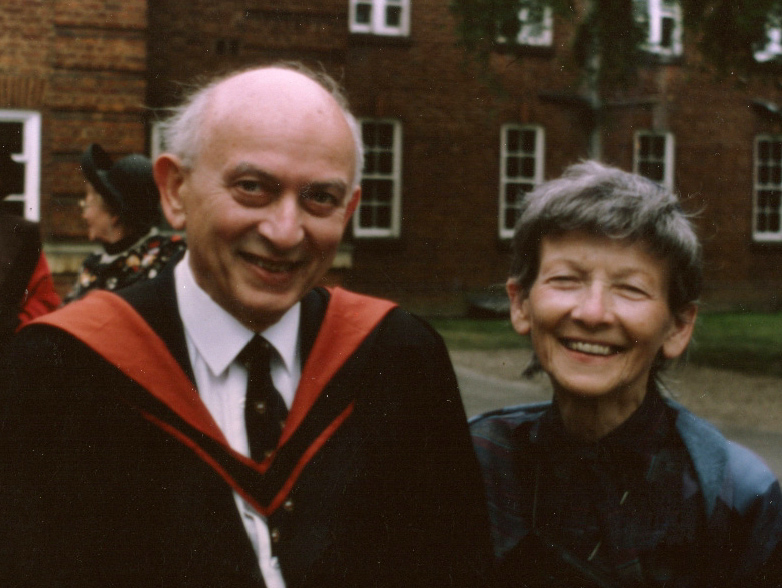
Solomon and Florence Asch
The social psychologist Solomon Asch was famous for his groundbreaking laboratory experiments. Asch insisted that lab investigation must maintain contact with real human experience, and that behavior cannot be separated from the social world of the individual. The mission and goals of the Asch Center reflect our commitment to Solomon Asch’s vision of balance between theoretical and practical concerns.
In a world drawn closer together through global commerce, culture and technology, no country is immune from the consequences of ethnic, political and religious conflicts. The United States has found that climate change, energy supply, financial equilibrium, and immigration all depend, in significant part, on political events beyond our borders. Salient in the turbulence of globalization, ethnopolitical conflict is perhaps THE major political problem of the 21st century.
For a decade the Solomon Asch Center for the Study of Ethnopolitical Conflict, now located at Bryn Mawr College, has brought together social scientists from many disciplines-history, political science, psychology, linguistics, economics, law, sociology or anthropology — to analyze the underlying causes of ethnic conflict, how conflict can be managed constructively to avoid widespread violence, and how to ameliorate the refugee problems that flow from ethnic violence.
The unique contribution of the Asch Center is this interdisciplinary and holistic view of ethnic conflict. There are centers that focus on understanding the origins and special viciousness of ethnic conflict. Other centers focus on peace-building interventions designed to control or reduce ethnic conflict. Still other centers focus on assisting the tens of millions of refugees and displaced persons created by ethnic conflict. Only the Asch Center attempts to understand these issues in their complex interrelations. We believe that the protracted nature of ethnic conflict often depends on the plight and politics of diasporas, that useful interventions to control ethnic conflict depend on understanding the special mobilizing power of ethnicity, and that assisting refugees to return to their homes depends on interventions that can help move violent conflict toward nonviolent political competition.
Substantively, the Center’s current work emphasizes four issues of ethnic conflict:
- ethnic mobilization
- postconflict peace-building
- visual culture in both mobilization and peace-building
- political psychology of ethnic diasporas
The Asch Center seeks to build research and education on these issues with support for the following activities: continuing the summer institutes that introduce young scholars and NGO officers to interdisciplinary perspectives on ethnic conflict; developing postdoctoral fellowships to bring together scholars working on Asch issues; developing a summer course for high school students interested in ethnic conflict; developing summer and semester internships for undergraduate students interested in ethnic conflict; launching a yearly film festival built around ethnic conflict issues; continuing Asch’s weekly seminar series; and developing the Asch Center website as a resource for studying the role of visual culture in ethnic conflict. Support for research and intervention projects can draw on the cooperation of the 78 fellows Asch has trained in its four past summer institutes, including fellows from India, the Philippines, Thailand, Sri Lanka, South Africa, Israel-Palestine, and Northern Ireland.